Nuremberg Rally Grounds

(This article was originally about my 2008 visit. My brother and I had the fortune of visiting together a decade later, and so I rewrote this in September, 2026 to be an amalgamation of both visits.)
For all of my life I’ve had an interest in history, mostly cold war history, but World War II history as well. As a kid I’d read books, stare at maps, marvel at photographs. So when I had an opportunity in 2008 to go work in Europe for a few months as part of the team investigating the Siemens bribery scandal, I immediately jumped on it.
The team worked 12 hour days in the City of Erlangen (a short train ride away from Nuremberg), which left very little downtime during the week. However, the weekends were all ours. While my co-workers took the weekends to fly to exotic locations all around Europe, I spent one weekend exploring around Nuremberg.
When I originally visited the site of the former rally grounds in 2008, I thought I’d never have a chance to go back. A decade later, my brother joined me in absorbing the history surrounding the city of Nuremberg.

My first visit in 2008 was on a cool day: -9 degrees Celsius when I left my hotel. Having survived -30 or worse that winter back home in Canada, the temperature combined with the brilliantly clear day made it feel practically like spring. I took the number nine tram from Nürnberg Hbf to the Documentation Center located in the massive Kongresshalle. As the tram rounded the corner to my stop, it was obvious that I had found the right place.
I knew the Kongresshalle was going to be big, but I wasn’t as prepared for how ominous the thing looked. I was aware that Hitler had a penchant for large, monolithic structures that conveyed power. As a kid, I had seen photos of the Kongresshalle many times. But I was still somehow unprepared when the tram went around that corner.
The next stop of any self-guided walk, after the Kongresshalle, is the Ehrenhalle, or ‘Hall of Honour.’ This monument was originally built to honour fallen soldiers of World War I, but Hitler perverted it during the Third Reich as part of their cult of the dead. It became the site of many fantastical gatherings of tens of thousands of SA and SS members during the Nuremberg Rallies.
When I first visited in 2008, the Ehrenhalle was covered with scaffolding, undergoing restoration work. A decade later, scaffolding gone, it looked as impressive as ever:
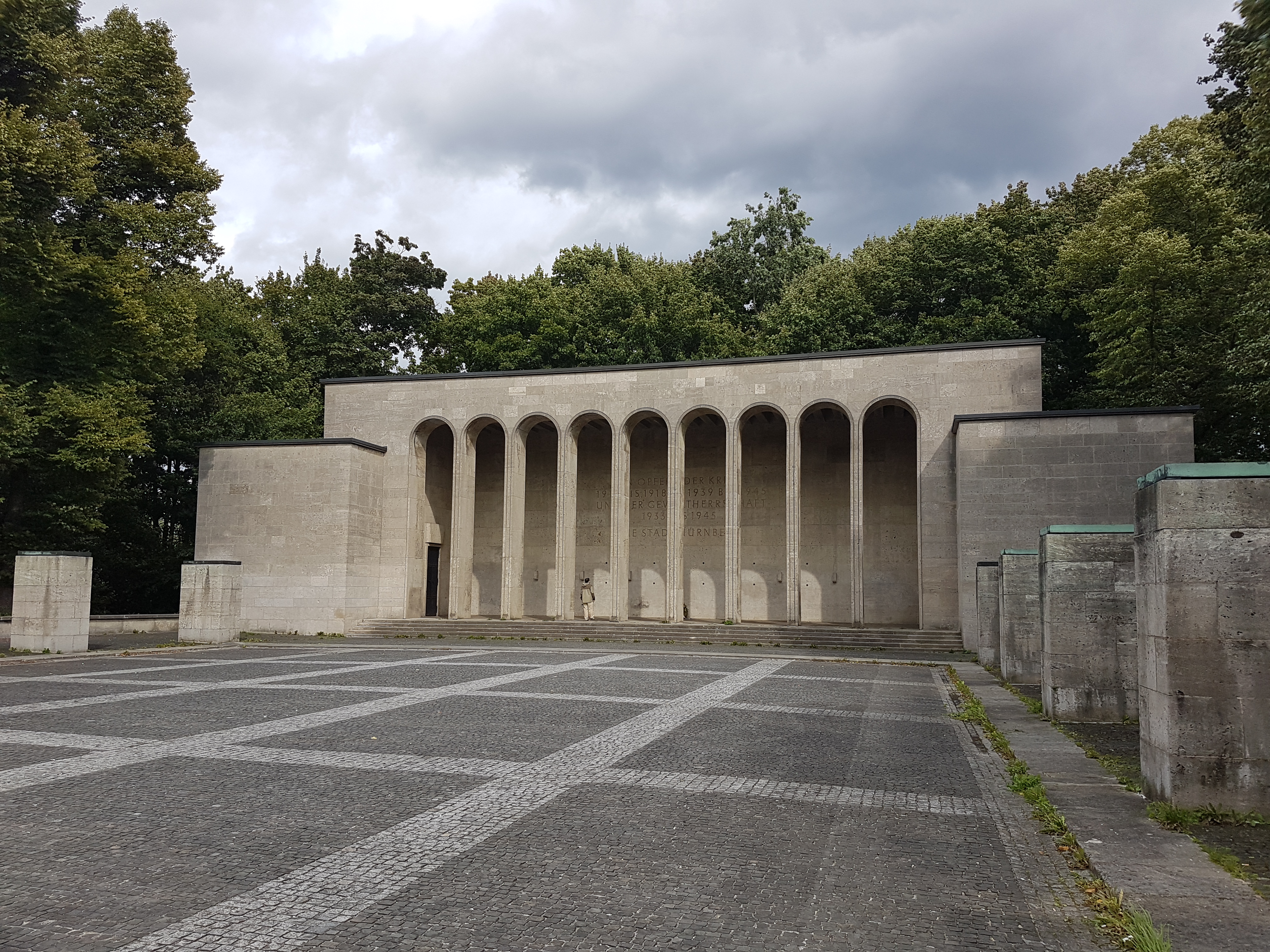

The Ehrenhalle faces the old Luitpold Arena, now a park for people to walk their dogs or have a picnic lunch. On the face of it, you’d have no idea that this great bowl of trees, grass, and dirt hosted some of the most fearsome military rallies on Earth. Just taking a walk across the grass gave my brother and I a great sense of the distances involved, and how many soldiers and Nazi members you could pack into such an area.

The great rows of seats on the opposite end of the arena were torn down after the war. However, bits and pieces of it can still be found embedded into the hillside. I knew that Hitler & Speer were big fans of solid granite for Nazi construction projects, but I never had an appreciation for how distinctive granite really is until I experienced it up close. For the rest of the day, it was easy to pick out relics from the Nazi era, if only by the granite appearance alone:

From there, it was time to walk back past the great Kongresshalle and the Documentation Center to the Zeppelin Field. And there, perhaps the most famous building of all: the Zeppelintribüne.
Many of Hitler’s filmed speeches were made here, from his podium on the Zeppelintribüne at the Zeppelin Field. This was also the location of the famous video of the US Army blowing up the giant swastika (“das Hakenkreuz”) atop the building.

At the time of my visit in 2008, and again a decade later, the Zeppelintribüne was slowly decaying. Water intrusion among other problems had caused the City of Nuremberg to remove bits and pieces of it to make it a little more safe. The podium where Hitler stood had been reconstructed, so while the modern-day podium is not the exact spot he made his speeches, it is a close enough approximation.


As of this writing in 2026, the City of Nuremberg has decided to undertake a major restoration of the Zeppelintribüne.
Next, we turned west towards Große Straße, a wide avenue tiled with solid granite blocks. Speer originally intended for this street to be two kilometers long, used for parading troops and other marching formations between a corridor of people lined up to see the spectacle. Only 1.5 kilometers of the road was completed, and it was never used for its intended purpose. My brother and I did, however, walk its entire length back to the Kongresshalle.

I visited the Documentation Center during my first trip in 2008, a museum and education centre established by the City of Nuremberg to document the concequences of Nazism and to preserve the history of the Nuremberg Rally Grounds. I found the information inside of the Documentation Center to be well preserved and presented. In 2008, admission was five euro.

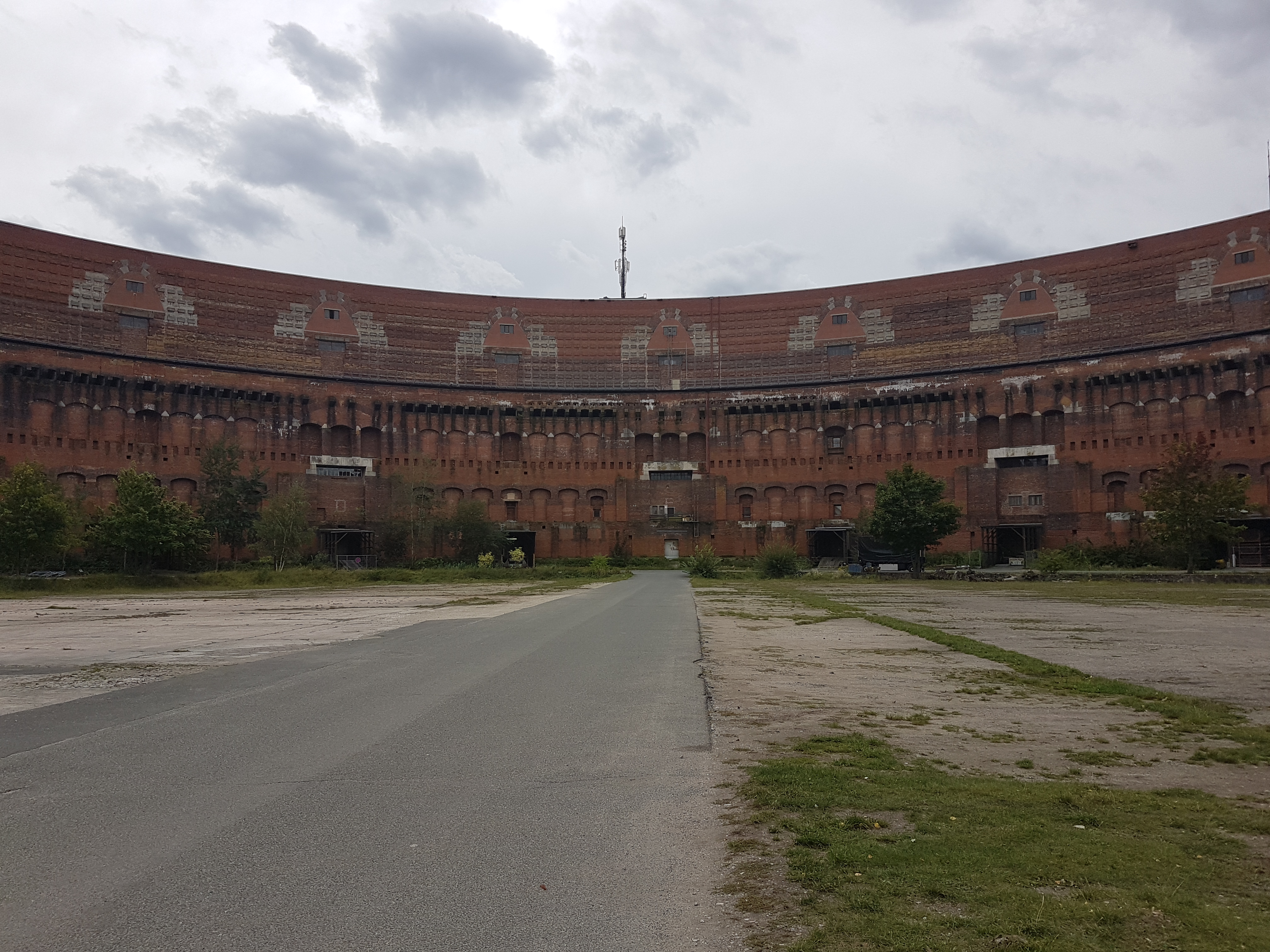
I was a little disappointed that there was no option to receive a tour of the Kongresshalle itself, despite the Documentation Center being embedded into a corner of it. They did, however, have a viewing deck that overlooked the inner courtyard. As you can see from the picture, only the outer layer of the building is granite — everything else was constructed by using regular brick.
This is a photo I took in 2008:

A photo from my brother a decade later:
We were quite hungry after a whole day of exploring the old rallying grounds, so, we decided to go in search of a rather unusual artifact of the Nazi era. The building shown in the photo below used to be a power substation that provided power to the over one-hundred spotlights used during the “Cathedral of Light” at Zeppelin Field (among other infrastructure on the rally grounds). In the photo, you can clearly see where the emblem of a Nazi eagle clutching a swastika was chiseled off of the building.
This is what the old power station looked like in 2008:

…and a decade later - not much has changed:
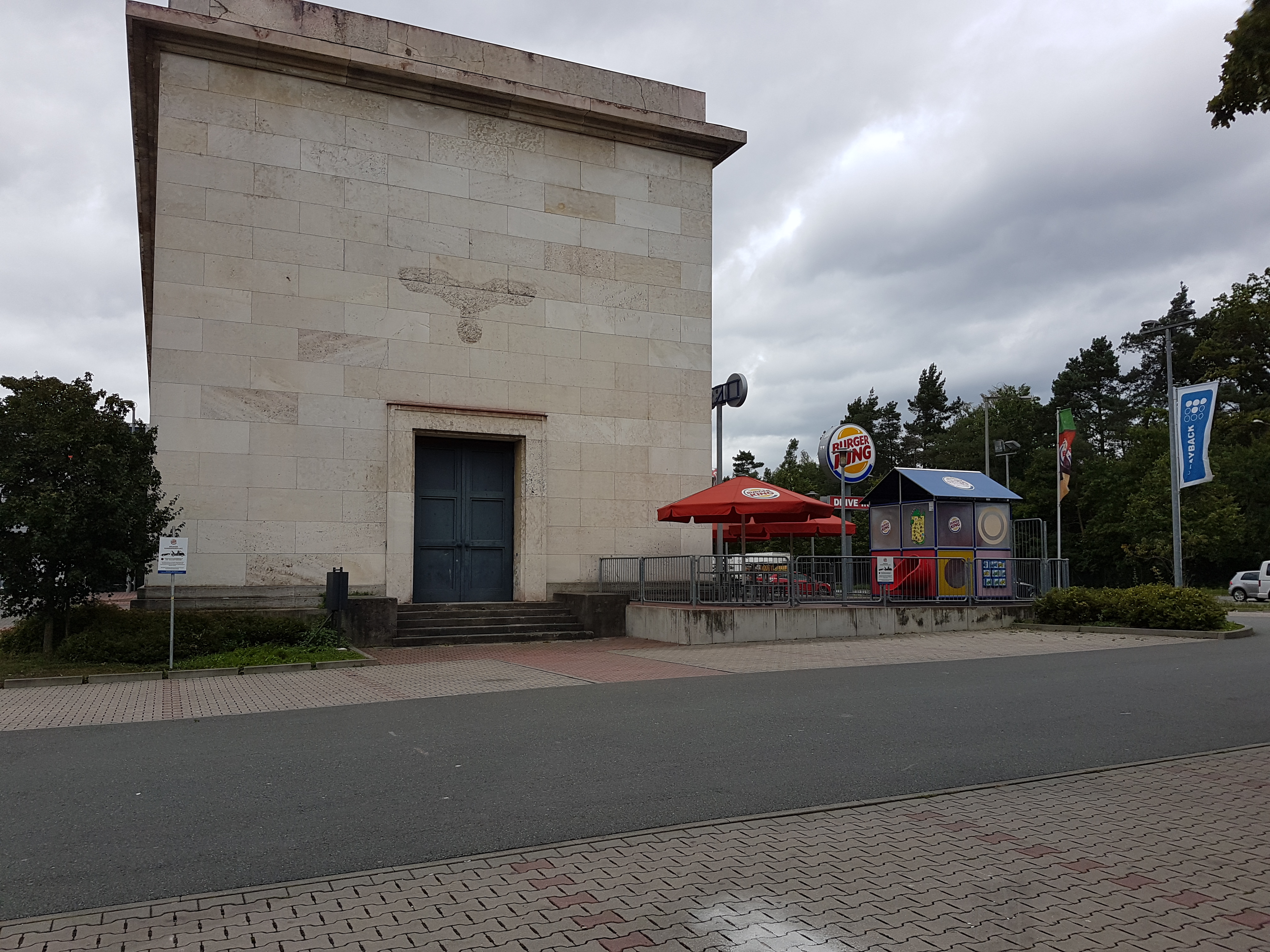

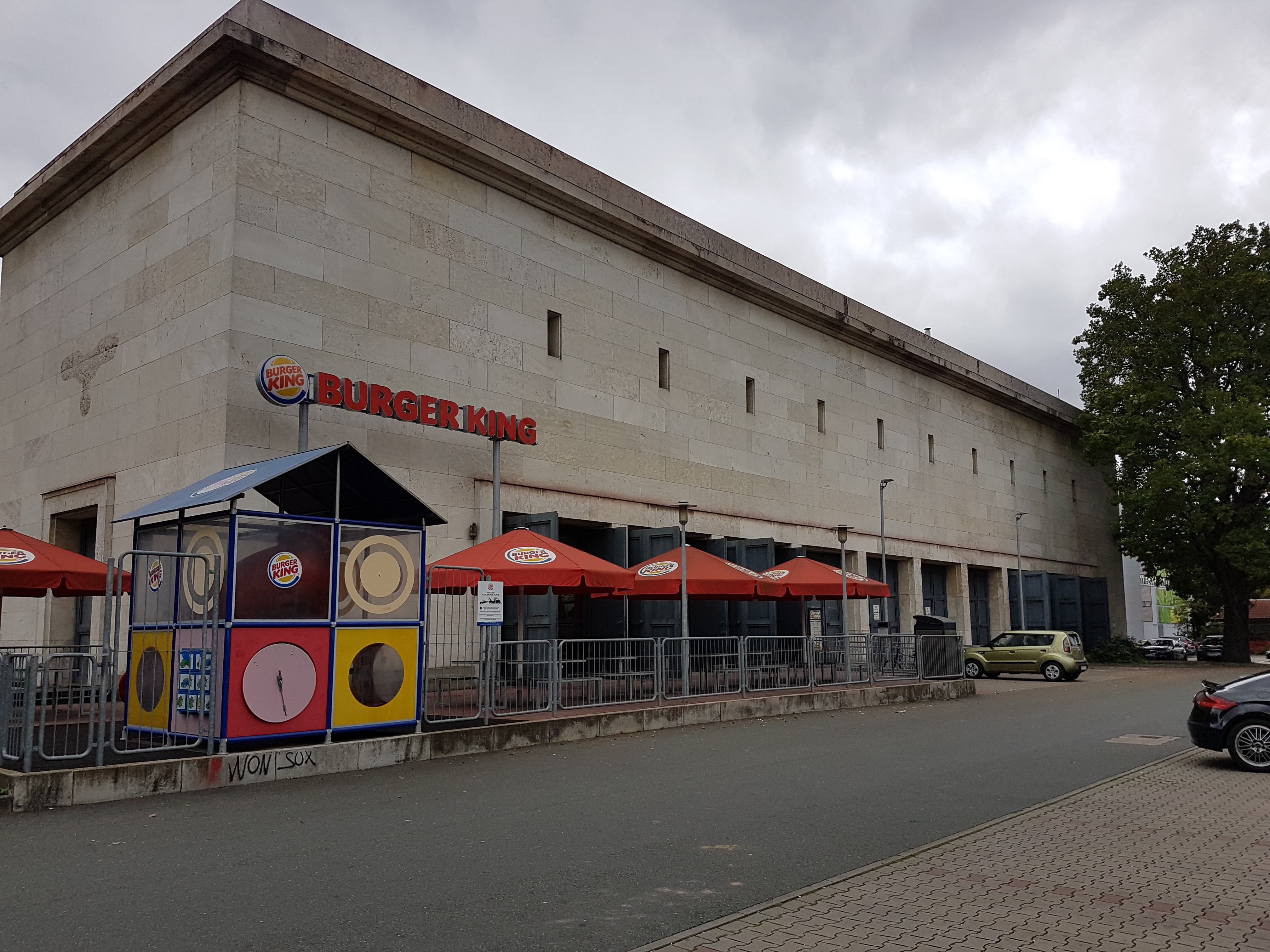
Now, it’s a Burger King! To be able to have lunch in such a historic building was special in its own way (even if it was Burger King).
With that done, it was time to go back to Nürnberg Hbf. Here are some photos my brother and I took along the way, old and new:

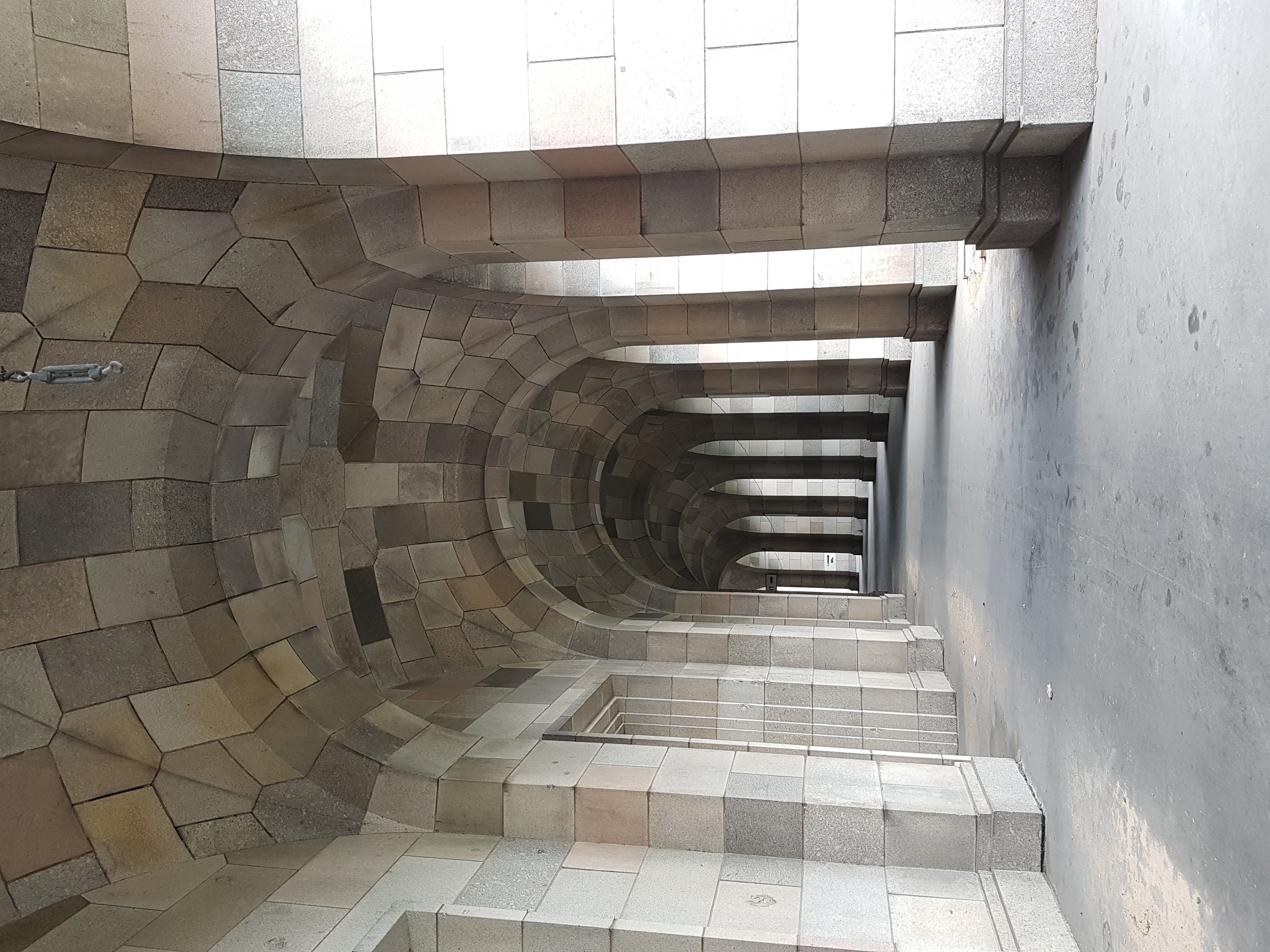
This is a photo I took of the Kongresshalle’s Arkadengang (arcade) in 2008, apparently signposted for vehicle traffic:

A decade later, a similar view of the Arkadengang but from my brother’s camera: